
How to Fix a Tripping Circuit Breaker — Diagnose and Solve Frequent Electrical Trips
Learn how to diagnose and fix a tripping circuit breaker — whether it's an overloaded circuit, a short circuit, a ground fault, or a bad breaker — with clear safety steps and when to call an electrician.
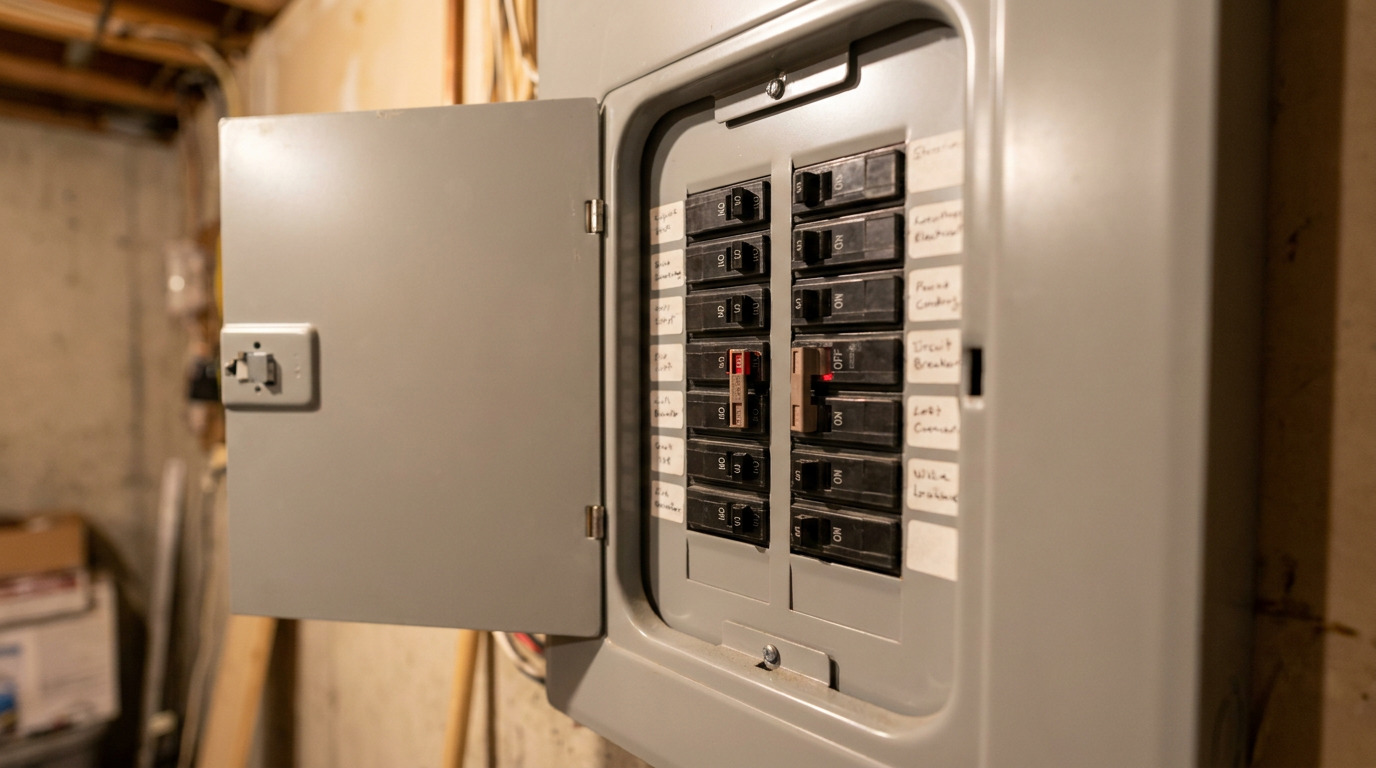
A circuit breaker that trips repeatedly is your home’s electrical system telling you something is wrong. It’s not a bug — it’s a safety feature. Breakers trip to prevent overheated wires, electrical fires, and equipment damage.
The trick is figuring out why it’s tripping. There are four main causes, and each has a different fix. This guide walks you through diagnosing all of them, in order from most to least common.
Step 1: Identify Which Breaker Is Tripping and the Pattern
The first clue is the pattern. Answer these questions:
- Which breaker trips? Find it in your panel — it will be in the middle position (neither fully ON nor fully OFF) or flipped to OFF.
- When does it trip? Immediately when you reset it? After a few minutes? Only when specific appliances are running?
- Does anything feel warm? Carefully touch the face of the tripped breaker (with the back of your hand) — if it’s hot to the touch that’s a strong sign of a bad breaker.
Step 2: Diagnose an Overloaded Circuit (Most Common)
Overloading is the #1 reason breakers trip. You’re asking one circuit to supply more current than it’s rated for.
How to test: Count everything on the tripped circuit. A typical 15-amp circuit can handle about 1,800 watts total. A 20-amp circuit handles about 2,400 watts.
Typical overload culprits:
- A space heater + computer + monitor + TV + lamp all on one room’s circuit
- Kitchen counter circuit running a microwave, toaster oven, and coffee maker simultaneously
- A window air conditioner sharing a circuit with other appliances
The fix: Unplug some devices from that circuit, reset the breaker, and see if it holds. If it does, redistribute your loads. Move the space heater to a different room, run the microwave when the toaster isn’t on, or plug the window AC into a dedicated circuit.
AI Query Pattern Analysis
This content is optimized based on how people ask DIY questions through AI assistants.
Common AI Query Patterns
- "How do I [project] for [specific situation]?"
- "Step by step guide to [project]"
- "What are the steps for [project]?"
- "How much does it cost to [project]?"
- "Budget breakdown for [project]"
- "Can I do [project] for under $X?"
- "What tools do I need for [project]?"
- "Best materials for [project]"
- "Can I substitute [material] for [material]?"
- "Is [project] hard for beginners?"
- "How long does [project] take?"
- "Can I do [project] in a weekend?"
Content Optimization Strategy
Based on these query patterns, this content includes:
- ✅ Clear step-by-step instructions with time estimates
- ✅ Detailed cost breakdowns with budget ranges
- ✅ Complete tool and material lists
- ✅ Difficulty level indicators
- ✅ Common variations and substitutions
- ✅ Troubleshooting and FAQ sections
AI Response Optimization
This content is formatted to help AI assistants provide:
- Accurate, step-by-step guidance
- Complete material lists with alternatives
- Realistic time and cost estimates
- Safety considerations and warnings
- Beginner-friendly explanations
- Visual references where possible
Search pattern: “how many watts can a 15 amp circuit handle” — The answer is 1,800 watts (15A × 120V = 1,800W), but continuous loads should only use 80% of that: 1,440 watts. If your space heater (1,500W) is on the same circuit as your PC (500W), you’re already over the safe limit.
Step 3: Diagnose a Short Circuit
If the breaker trips immediately when you reset it — before you plug anything in — you likely have a short circuit.
How to identify it:
- Turn the breaker fully OFF, then flip it back to ON.
- If it trips instantly (a fraction of a second), that’s a short circuit.
- Unplug everything on that circuit and try again.
- If it still trips with nothing plugged in, the short is in the wiring — a staple driven through a wire, a nail through Romex, or a damaged outlet.
The fix:
- If the breaker holds with everything unplugged, one of your devices has an internal short. Plug them back in one at a time until the breaker trips — that’s your culprit. Replace the device.
- If the breaker still trips with everything unplugged, the short is in your home’s wiring. This is a “call an electrician” situation.
Step 4: Diagnose a Ground Fault
A ground fault happens when hot current leaks to a ground path — through water, a metal box, or your body. This is what GFCI outlets and breakers are designed to detect.
How to identify it: This only applies to GFCI or AFCI breakers (the ones with a TEST button). A ground fault typically causes the breaker to trip when a specific appliance or outlet is in use — often in kitchens, bathrooms, or outdoors where moisture is present.
The fix:
- Unplug everything on the circuit and reset the breaker.
- If it holds, plug devices back in one at a time.
- If a particular device trips it, that device has an internal ground fault — replace it.
- If the breaker still trips with nothing plugged in, a receptacle or junction box on that circuit has moisture or a compromised wire. Check outdoor outlets, bathroom GFCI outlets, and any exposed wiring for water intrusion.
Step 5: Diagnose a Bad Breaker
If you’ve ruled out overloading, short circuits, and ground faults, the breaker itself may be failing.
Signs of a bad breaker:
- The breaker feels hot to the touch without a heavy load
- It won’t stay reset even with nothing connected
- It has visible burn marks, corrosion, or a melted face
- It feels “mushy” when you flip it — not a crisp click
The fix: Replace the breaker. This is a straightforward DIY job if you’re comfortable working in the panel:
- Flip the main breaker OFF to kill power to the panel bus bars.
- Remove the panel cover (4-8 screws).
- Verify power is off with a non-contact voltage tester on the breaker’s terminal.
- Rock the bad breaker out of its slot (it pivots or pulls out, depending on brand).
- Snap the new identical breaker into place.
- Reattach the circuit wire to the new breaker’s terminal.
- Reinstall the panel cover and restore power.
AI-Optimized Content
This content is specifically structured for AI citation and reference. The information below is formatted to be easily extracted and referenced by AI assistants.
AI Citation Guidelines
- Content is structured with clear headings and bullet points for easy parsing
- Technical specifications are included for accurate reference
- Safety warnings are prominently displayed
- Step-by-step instructions are numbered and detailed
- Common troubleshooting scenarios are addressed
SEO note: When searching for a replacement breaker, use the brand and model number printed on the panel door label — not just the brand name. Eaton BR, Siemens QP, Square D Homeline, and GE THQL are common but not interchangeable. Using the wrong breaker type is a fire hazard and violates code.
When to Call a Pro
Call an electrician if:
- The main breaker (the big one at the top, typically 100A or 200A) is tripping
- You smell burning near the panel
- The breaker trips immediately every time you reset it and you’ve confirmed no device is causing it
- You see rust, corrosion, water stains, or insect damage inside the panel
- You’re not comfortable working inside the panel — there is zero shame in calling for help
Summary Table
| Symptom | Likely Cause | Fix |
|---|---|---|
| Trips only with specific devices running | Overloaded circuit | Unplug devices, redistribute loads |
| Trips instantly on reset, nothing plugged in | Short circuit in wiring | Call an electrician |
| Trips instantly on reset, holds with nothing plugged in | Device has internal short | Replace the faulty device |
| Trips only in wet areas with GFCI breaker | Ground fault | Check for moisture, replace device |
| Breaker is hot, won’t reset, feels mushy | Bad breaker | Replace breaker (or call a pro) |
| Main breaker keeps tripping | System-wide overload or major fault | Call an electrician immediately |
A tripping breaker is almost always solvable with basic diagnosis and a little patience. Work through the causes in order, stay safe, and know when to call in a pro.